





Real-time
Assessment documentation
La Trobe Palliative Care Research Programme
PCAT is a research-backed digital platform developed at La Trobe University to help nursing teams in aged care identify patients who need palliative care earlier, more consistently, and with confidence. Structured assessments, predictive trend analysis, and clear escalation pathways, all in one secure portal.
Real-time
Assessment documentation

Secure
Role-based nurse access

Analytics
Patient outcome tracking

AI-First
Built for intelligent care
About the project
PCAT was developed under Professor Hanan Khalil's initiative at La Trobe University to close a critical gap in aged care nursing: the timely identification of patients who would benefit from palliative care. Where nurses once relied on fragmented paper forms and disconnected processes, PCAT brings everything into one structured, evidence-based digital workflow.
PCAT is an evidence based palliative care assessment toolkit that is designed to flag palliative care needs. Nurses can complete assessments, monitor patient health trends over time, review full care histories, and ensure no at-risk patient goes unnoticed — all from a single secure portal, on any device.

Develop and validate an AI-powered screening tool that identifies aged care residents with unmet palliative care needs earlier and more accurately than current practice.

Residents of Australian residential aged care facilities, with a focus on those with complex chronic conditions, dementia, and advanced frailty.

Mixed-methods approach combining clinical data analysis, machine learning model development, and co-design with aged care staff, residents, and families.

An AI first evidence based prototype for aged care providers to support policy recommendations for palliative care identification in residential and community settings.
Core Features
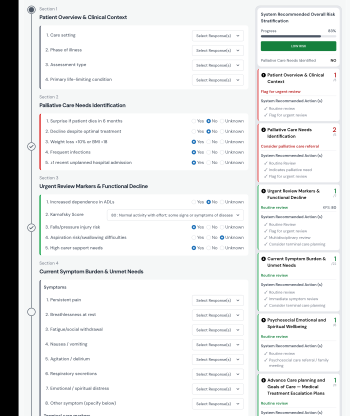








Complete structured palliative care assessments built on peer-reviewed methodology. Forms are standardised, auto-timestamped, and designed so no critical clinical indicator is ever overlooked.

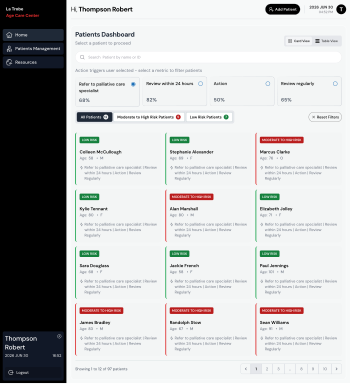
Assessment responses automatically surface risk indicators and suggest appropriate clinical actions. Senior nurses and administrators can filter all patients by risk level, ensuring priority cases are always visible.

PCAT is architected from the ground up to integrate AI capabilities — enabling future features like predictive risk scoring, clinical trend analysis, and intelligent decision support.

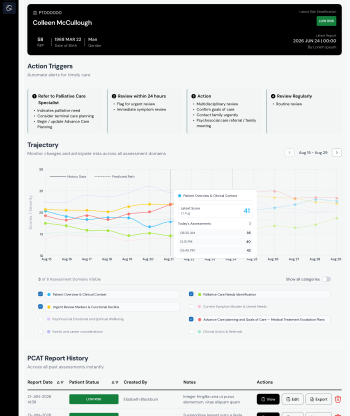
Visualise a patient's assessment score history and a model-generated 48-hour forecast — giving nurses an early signal of deterioration before it becomes critical.

PCAT supports multiple aged care centres under the same programme. Each nurse sees only the patients assigned to their facility, while coordinators retain a cross-centre overview.

Nurses and administrators operate within tailored permission sets. Full audit logging ensures accountability, and all patient data is protected behind authenticated, encrypted access.
How It Works


Use your PCAT credentials to access the portal. Your assigned facility and patient list load automatically upon sign-in.


Browse your patient list filtered by risk level, recent activity, or name. High-priority patients are surfaced immediately.


Work through the structured, research-validated assessment form. Guided prompts ensure every clinical indicator is captured.


Based on the assessment responses, PCAT surfaces recommended clinical actions and flags risk indicators.


Examine an interactive chart showing the patient's assessment score history over the past 7 days, alongside a model-generated trend forecast.


At the end of each shift, PCAT compiles an up-to-date summary of each patient's status, recent assessments, and outstanding actions.
Research team
Principal Investigator
Prof. Hanan Khalil
Lead researcher and grant recipient. Professor in the School of Psychology and Public Health, with expertise in evidence synthesis, aged care, and health services research.
La Trobe University - School of Psychology and Public Health
Digital health Lead
Dr. Urooj Raza Khan
Leads project management and provides digital health research leadership, ensuring seamless delivery, effective cross-functional collaboration, and strong alignment with grant requirements across all stakeholders.
La Trobe University · School of Psychology and Public Health
Business Analyst
Pasindu Galgomuwa
Bridging the gap between clinical requirements and technical implementation, translating research needs into the platform's digital architecture.
La Trobe University
Co-Investigators
Research Team
A multidisciplinary team spanning clinical informatics, palliative medicine, aged care nursing, and health technology design.
La Trobe University · ARIIA
Clinical Advisors
Advisory Committee
Aged care providers, specialists, consumer representatives, and family advocates who co-design and validate PCAT.
Partner Organisations
Platform Engineering
ODDLY Global
Technical partner responsible for the end-to-end platform design, UI/UX architecture, and software engineering of the PCAT application.
Technology Partner
Funding & Governance
PCAT is supported by La Trobe University, Aged Care Research and Industry Innovation Australia (ARIIA) and Monash Health.

Host institution

Funding partner

Healthcare partner
FAQ
Everything you need to know before logging in.
Log in to PCAT and take the next step in delivering better palliative care.
Get in touch
We welcome enquiries from aged care providers, clinicians, researchers, consumer advocates, and organisations interested in partnering with the PCAT project.
This research is conducted in accordance with La Trobe University's Human Research Ethics framework and relevant aged care legislation. All data collection and use is subject to participant consent and institutional ethics approval. For ethics enquiries, contact the La Trobe University Research Ethics team.